

 English
 Español
.jpg?imageView2/2/w/800/h/800/format/webp/q/75 "Viscose Core Spun Yarn")
.jpg?imageView2/2/w/800/h/800/format/webp/q/75 "Acrylic Core Spun Yarn")
.jpg?imageView2/2/w/800/h/800/format/webp/q/75 "Polyester Core Spun Yarn")
.jpg?imageView2/2/w/800/h/800/format/webp/q/75 "Anti-pilling Acrylic Core Spun Yarn")
.jpg?imageView2/2/w/800/h/800/format/webp/q/75 "Rabbit Hair Core Spun Yarn")
.jpg?imageView2/2/w/800/h/800/format/webp/q/75 "Rabbit Velvet Core Spun Yarn")
.jpg?imageView2/2/w/800/h/800/format/webp/q/75 "Multicolor Core Spun Yarn")
.jpg?imageView2/2/w/800/h/800/format/webp/q/75 "Wooly Core Spun Yarn")
.jpg?imageView2/2/w/800/h/800/format/webp/q/75 "Metallic Core Spun Yarn")
.jpg?imageView2/2/w/800/h/800/format/webp/q/75 "Colorful Nep Core Spun Yarn")
.jpg?imageView2/2/w/800/h/800/format/webp/q/75 "Space Dyed Core Spun Yarn")
.jpg?imageView2/2/w/800/h/800/format/webp/q/75 "Shiny Core Spun Yarn")

 Click to view
“The company adheres to the business philosophy of 'You Win, I Win' ”
Content
Imagine you are a fabric buyer or product developer trying to reduce the environmental footprint of your next collection. The term recycled polyester fiber keeps appearing in material libraries, supplier emails, and sustainability reports. It sounds like an obvious win—plastic bottles turned into textiles. The reality is more nuanced. Recycled polyester fiber is a genuinely useful, lower-impact alternative to virgin polyester, but it is not a perfect material. Its benefits depend on how the plastic is collected and recycled, how the fiber is spun into yarn, and how long the final product remains in use.
What Is Recycled Polyester Fiber?
Recycled polyester fiber, often shortened to rPET fiber, is a synthetic fiber made by recovering PET plastic from discarded bottles and, increasingly, from post-industrial polyester waste. The plastic is sorted, cleaned, shredded, melted, and extruded through spinnerets to form continuous filaments. Those filaments can be cut into staple fiber for spinning into yarn, or used directly as filament yarn for weaving and knitting.
Mechanical recycling is the most common route: the PET polymer is washed, melted, and respun, which preserves the basic polymer structure but can shorten polymer chains slightly. Chemical recycling, which breaks the polyester down into monomers and re-polymerizes it, produces fiber closer to virgin quality but at a higher cost. In both cases, the output is a fiber that performs very much like virgin polyester in strength, durability, and dimensional stability.
From a sourcing perspective, this means you can often substitute recycled polyester fiber for virgin fiber without re-engineering the entire fabric. The hand feel, draping behavior, and dyeing characteristics can be adjusted through yarn structure and spinning parameters.
Recycled Polyester Fiber vs. Virgin Polyester: Key Comparisons
To understand where recycled polyester fiber fits, it helps to compare it directly with virgin polyester on the factors that matter most in textile production.
| Aspect | Recycled Polyester Fiber | Virgin Polyester Fiber |
|---|---|---|
| Raw material | PET bottles and post-industrial waste | Petrochemicals derived from crude oil |
| Production energy | Roughly 59% less energy to produce | Higher energy demand in monomer production |
| Carbon footprint | Generally lower in lifecycle assessments | Higher, depending on refinery and polymer process |
| Fiber quality | Comparable strength and shrinkage resistance | Consistent virgin polymer quality |
| Microplastic release | Sheds microplastics during washing | Sheds microplastics during washing |
The energy saving is substantial, which is one reason many brands have adopted recycled polyester. However, the table also shows that rPET is not a zero-impact material. The environmental profile becomes attractive only when the fiber is manufactured efficiently, dyed with care, and used in a product with a long active life.
Benefits That Matter for Textile Manufacturers
Keeping Plastic Waste Out of Landfills
Recycled polyester fiber gives a second life to PET bottles and manufacturing offcuts that would otherwise be burned or buried. For a textile company, using rPET supports waste diversion goals without requiring dramatic changes to fabric construction.
Lower Reliance on Virgin Fossil Feedstocks
Because rPET uses already-polymerized PET, it reduces the demand for petroleum-derived raw materials. This is not circularity in the strictest sense, but it does lower the energy and resource input associated with the first stage of polymer creation.
Performance and Versatility in Yarn
Polyester fiber is valued for its resilience, quick-drying behavior, and ease of care. When spun into yarn, recycled polyester can be engineered for different applications. For instance, a high-bulky polyester yarn gives knitwear a soft, lofty feel with good thermal insulation, making it suitable for sweaters and blankets. The same base fiber can be blended with cotton, viscose, or spandex, either in the spinning process or through core-spun construction, to achieve different stretch and comfort profiles.
.jpg?imageView2/2/w/800/h/800/format/webp/q/75) Custom High Bulky Polyester Yarn Suppliers,FactorySuzhou RHZ Textile Technology Co., Ltd. is China Custom High Bulky Polyester Yarn Suppliers,Factory,High Bulky Polyester Yarn is stretch...View Product →
Custom High Bulky Polyester Yarn Suppliers,FactorySuzhou RHZ Textile Technology Co., Ltd. is China Custom High Bulky Polyester Yarn Suppliers,Factory,High Bulky Polyester Yarn is stretch...View Product →
There is also a practical benefit for manufacturers: recycled polyester fiber can be handled on the same spinning and knitting equipment used for virgin polyester. The conversion cost is mainly in feedstock collection and sorting, not in production ramp-up.
Honest Limitations and Environmental Trade-Offs
If recycled polyester fiber were completely problem-free, the switch would already be universal. The limitations are real and worth understanding before making sourcing decisions.
Microplastic Shedding
Like all synthetic fibers, recycled polyester sheds microplastic particles during washing. Mechanical recycling does not change the fiber chemistry, so rPET clothing contributes to microplastic pollution just as virgin polyester does. Using lower-friction spinning techniques, tighter yarn twist, and fabric coatings can reduce shedding, but not eliminate it.
Downcycling Rather Than Closed-Loop Recycling
Most PET bottles become polyester fiber only once. At the end of its life, an rPET garment is unlikely to be collected and recycled back into fiber of the same quality. The process is therefore often described as downcycling, which extends the value of the material but does not create an infinite loop.
Dyeing and Finishing Still Carry an Impact
Recycled polyester must still be dyed, and dyeing requires heat, water, and chemicals. The sustainability outcome depends heavily on whether the mill uses energy-efficient dyeing processes and proper water treatment. Fiber choice alone does not guarantee an eco-friendly product.
Buying Considerations: From Fiber to Finished Yarn
When you evaluate recycled polyester fiber or yarn, the starting point should be certification and supply-chain transparency. Look for materials certified under the Global Recycled Standard (GRS) or the Recycled Claim Standard (RCS), because these verify recycled content and trace the material back to its recovery source. A quick checklist for sourcing recycled polyester fiber includes:
- Verify GRS or RCS certification.
- Confirm the fiber source and recycling method.
- Match yarn structure to the end-use application.
Next, consider what you need from the yarn in practical terms. Fiber length, crimp, and spinning method all affect the final fabric. A yarn with high bulk and softness is often built on open-end or vortex spinning, while a smooth compact yarn is better produced on ring spinning with precise settings. Our own production experience shows that these choices matter as much as the raw fiber origin. With more than 20 years in the yarn business, we have learned how to balance strength, softness, and cost in polyester yarns, a lesson we have developed throughout our manufacturing history.
For stretch applications such as sportswear and form-fitting knitwear, a polyester core-spun yarn is a common solution: the outer fibers provide cover and hand feel, while the elastic core supplies recovery.
.jpg?imageView2/2/w/800/h/800/format/webp/q/75) Custom Polyester Core Spun Yarn Suppliers,FactorySuzhou RHZ Textile Technology Co., Ltd. is China Custom Polyester Core Spun Yarn Suppliers,Factory,Polyester Core Spun Yarn is made by P...View Product →
Custom Polyester Core Spun Yarn Suppliers,FactorySuzhou RHZ Textile Technology Co., Ltd. is China Custom Polyester Core Spun Yarn Suppliers,Factory,Polyester Core Spun Yarn is made by P...View Product →
For fabrics that need a clean, even surface—shirts, linings, or lightweight knits—a compact solid polyester yarn offers better stitch definition and fewer surface imperfections.
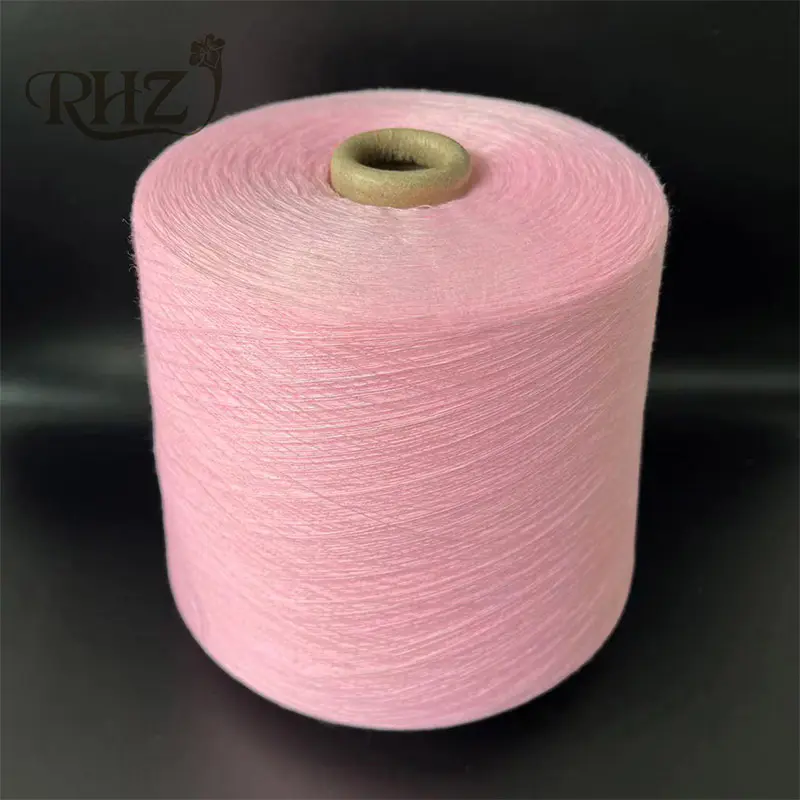 Custom Solid Polyester Yarn Suppliers,FactorySuzhou RHZ Textile Technology Co., Ltd. is China Custom Solid Polyester Yarn Suppliers,Factory,Polyester Spun Yarn refers to yarn spun f...View Product →
Finally, think about the product life cycle. Recycled polyester fiber is a worthwhile choice when the garment is durable, easy to care for, and ultimately recyclable. If the product is a fast-fashion item that will be discarded quickly, the environmental benefits of rPET are largely lost.
The Takeaway
Recycled polyester fiber is not a silver bullet, but it is a meaningful step forward when compared with virgin polyester. It saves energy, keeps plastic out of landfills, and offers performance close to the original material. The key is to use it responsibly: choose certified sources, select the right yarn structure for the intended application, and design for a longer useful life. For manufacturers and brands looking to reduce impacts without sacrificing quality, recycled polyester fiber—especially when converted into well-engineered yarn—deserves a place in the material mix.
